

How the Romans Stayed Cool: Lessons for Your Modern Terrace
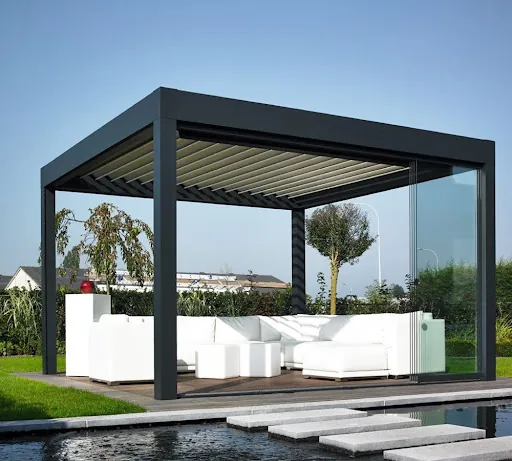
In the height of the Mediterranean summer, without electricity or modern technology, the Romans had already solved the heat problem. Their ingenious passive cooling techniques are still valid today.
The peristyle: the cool heart of the Roman villa
The peristyle was an interior porticoed courtyard with columns, a garden, and a central fountain. The evaporating water cooled the air, and the columns and vine-covered pergolas provided shade without blocking the breeze.
Today’s lesson: a pergola with adjustable louvers and a fountain or misting system recreates exactly this effect on your terrace.
The vine pergola: the first bioclimatic roof
The Romans covered their pergolas with deciduous vines. In summer, the leaves blocked the sun; in winter, when they fell, they let through the solar rays that warmed the villa.
Today’s lesson: the adjustable louvers of a modern bioclimatic pergola do exactly the same thing: you rotate them to block the sun in summer and open them to let in heat in winter.
Cross-ventilation
Roman villas were oriented to capture prevailing breezes. Windows and doors were strategically placed to create natural air currents.
Today’s lesson: combining a pergola with sliding glass curtains allows you to open the sides for ventilation or close them to protect from wind.
The eternal principle: collaborating with nature
The Romans didn’t fight the climate; they worked with it. That same principle guides the design of modern bioclimatic pergolas: instead of spending energy on air conditioning, we use sun, shade, and breeze intelligently.
2,000 years later, the technology has changed but the principle remains. At Pergolas Canarias, we apply this millenary wisdom with the best 21st-century materials.